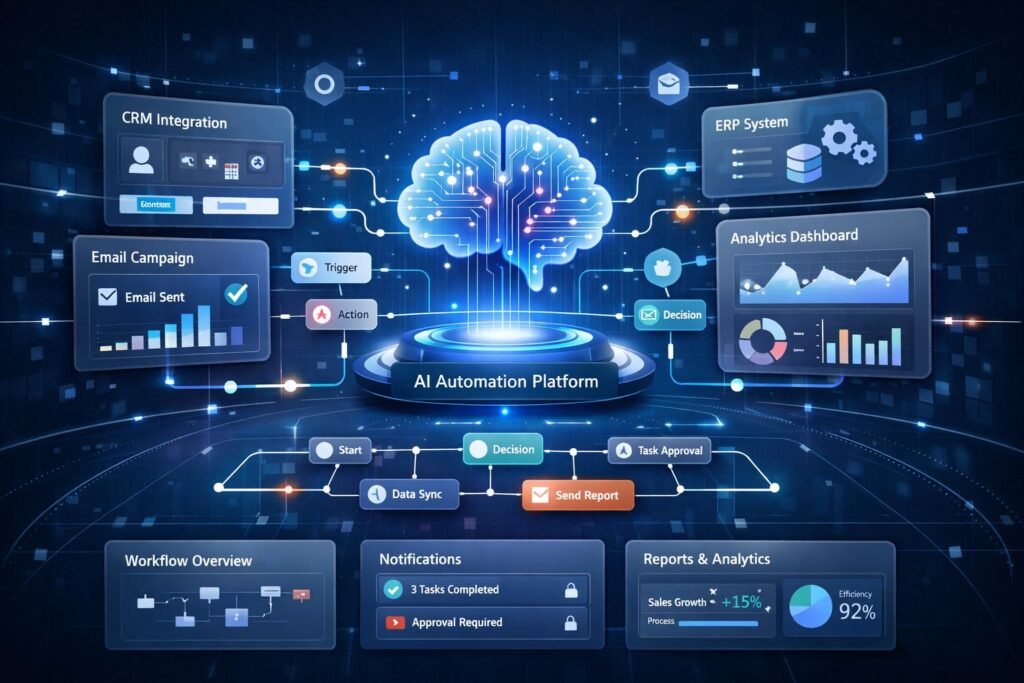

Artificial intelligence is changing the way businesses operate. Companies are exploring new ways to automate repetitive tasks, improve customer communication, manage leads, and connect their business applications.
However, many businesses do not have the technical knowledge or time required to build and maintain these systems themselves. They need professionals who can identify operational problems and implement automation solutions that deliver measurable results.
This creates an opportunity for entrepreneurs to start an AI automation agency.
An AI automation agency helps businesses streamline their operations using artificial intelligence, workflow automation tools, chatbots, and application integrations. Instead of selling AI as a general concept, an agency focuses on solving specific business problems.
For example, an agency might help a marketing company automate lead collection, connect its website to a CRM, classify incoming emails, and create follow-up reminders.
These services can save employees time and improve consistency when the systems are designed, tested, and maintained properly.
Starting an agency does not necessarily require a large office or a big team. You can begin with a focused service, learn the required tools, build practical demonstrations, and gradually develop your business.
In this guide, you will learn how to choose a niche, select automation tools, create service packages, find clients, price your services, and build a sustainable AI automation agency in 2026.
🤖 What Is an AI Automation Agency?
An AI automation agency is a service business that helps other companies automate selected tasks and workflows using AI technologies and software integrations.
Traditional digital agencies often focus on services such as website development, advertising, graphic design, or social media management.
An AI automation agency focuses on improving how business processes operate.
It may connect different applications, automate repetitive tasks, build AI chatbots, or introduce intelligent systems that help employees process information more efficiently.
Services an AI Automation Agency Can Offer
- ⚙️ Workflow automation: Connect business applications and automate repetitive processes.
- 💬 AI chatbot development: Build assistants that answer customer questions using approved information.
- 🎯 Lead generation automation: Capture, organize, and route sales inquiries.
- 📩 Email automation: Classify messages, prepare responses, and manage follow-up tasks.
- 📊 CRM automation: Keep customer records organized and trigger relevant workflows.
- 📄 Document processing: Extract and validate information from supported documents.
- 📅 Appointment automation: Connect customer inquiries with scheduling systems.
- 🔗 API integrations: Connect applications that do not have a suitable direct integration.
- 📈 Reporting automation: Collect data and prepare recurring reports.
You do not need to offer every service at the beginning.
A focused agency with one or two well-developed solutions may be easier to manage than a business that promises to automate every possible process.
🚀 Why Start an AI Automation Agency in 2026?
Businesses continue to adopt software to improve productivity, but many still rely on manual processes between their applications.
Employees may copy information between spreadsheets, answer repetitive questions, update CRM records, and prepare reports manually.
An automation agency can help identify these inefficiencies and implement appropriate solutions.
1. 💼 Businesses Need Practical Solutions
Many business owners are interested in AI but are unsure how to use it in their daily operations.
They may understand that AI can generate text or answer questions but need help connecting those capabilities to actual business processes.
An agency can bridge that gap by designing and implementing practical workflows.
2. 🌐 You Can Operate Remotely
Many automation services can be delivered online.
Client communication, workflow design, implementation, testing, and maintenance can often be managed remotely, depending on the project requirements.
This can reduce the need for a physical office during the early stages.
3. 🔄 Projects Can Lead to Ongoing Services
Some automation projects require regular monitoring, updates, and support.
For example, a company may need ongoing assistance to maintain its integrations, update its chatbot knowledge base, and resolve workflow failures.
This creates an opportunity to offer maintenance agreements alongside project-based work.
However, recurring revenue is not guaranteed. It depends on the value of the service, client retention, and the ongoing responsibilities agreed upon.
4. 📈 You Can Expand Gradually
You can begin by solving a simple problem for one type of business.
As your experience grows, you can add more integrations, develop reusable templates, and hire specialists when the workload justifies it.
5. 🧠 Technical and Business Skills Work Together
Successful automation requires more than knowing how to use AI tools.
You also need to understand business processes, communicate with clients, identify risks, and measure results.
Combining these skills helps you create solutions that address real operational needs.
🎯 Step 1: Choose a Profitable Niche
A niche is a specific industry, customer group, or business problem that your agency focuses on.
Choosing a niche can make marketing easier because you can develop services and examples around a recognizable set of customer needs.
Instead of advertising that you automate everything for everyone, explain which problems you solve best.
Potential Niches for an AI Automation Agency
🏠 Real Estate Agencies
Possible services include lead routing, property inquiry chatbots, appointment requests, and CRM updates.
📣 Marketing Agencies
You can automate lead collection, reporting, campaign notifications, and client onboarding tasks.
🛒 E-commerce Businesses
Potential solutions include customer support workflows, product inquiry routing, and internal order notifications.
💼 Consultants and Professional Service Providers
You can help manage inquiries, automate onboarding, organize client information, and prepare follow-up reminders.
🏋️ Fitness Studios and Gyms
Possible services include membership inquiries, trial-session requests, appointment workflows, and customer notifications.
🎓 Educational Businesses
You can automate course inquiries, enrollment-related communication, and administrative workflows using approved information.
How to Select the Right Niche
Evaluate each niche using these questions:
- Does the business perform repetitive tasks regularly?
- Is the problem important enough that the company may pay to solve it?
- Can the automation produce a measurable improvement?
- Can you reach decision-makers in that industry?
- Can you build a reliable demonstration without accessing sensitive client data?
- Are there legal, privacy, or industry-specific requirements you can meet?
Start with the niche where you can understand the problem and demonstrate a realistic solution.
🧰 Step 2: Learn the Essential AI Automation Tools
You do not need to learn every platform available. Begin with tools that match the services you intend to offer.
1. n8n
n8n is a workflow automation platform that connects applications, APIs, and AI models.
You can use it to build multi-step workflows involving form submissions, email processing, CRM updates, and notifications.
Useful for:
- Custom workflows.
- API integrations.
- AI-powered processing.
- Conditional routing.
- Complex automation logic.
It is especially worth exploring when you want greater control over your workflow design.
2. Make
Make provides a visual environment for connecting applications and building automated scenarios.
It can help you create workflows that transfer information between supported applications and follow defined conditions.
Useful for:
- Visual workflow design.
- Multi-step application integrations.
- Business process automation.
- Data transformation.
3. Zapier
Zapier connects supported applications through triggers and actions.
It can be useful for simpler business workflows, especially when the required applications already have suitable integrations.
Useful for:
- Form-to-CRM workflows.
- Email notifications.
- Task creation.
- Routine application connections.
4. AI Models and APIs
AI models can support tasks such as classifying customer messages, summarizing documents, extracting information, and drafting responses.
Learn how to connect a model to an automation platform, structure its output, and validate its responses.
5. CRM Platforms
A CRM helps businesses organize customer information, leads, sales opportunities, and follow-up activities.
Learn at least one CRM platform that suits your target niche.
6. Chatbot Platforms
Platforms such as Botpress and Voiceflow can help you design conversational experiences and build customer-facing assistants.
Choose a platform according to your required channels, integrations, knowledge sources, and support requirements.
Your Initial Learning Priorities
Focus on these skills first:
- Understanding triggers and actions.
- Working with APIs and webhooks.
- Mapping and transforming data.
- Using conditions and branching logic.
- Connecting AI models to workflows.
- Validating AI outputs.
- Handling failures and duplicate actions.
- Protecting API keys and customer information.
- Testing workflows with realistic data.
- Documenting and maintaining your systems.
You can learn additional tools as actual client projects require them.
🛠️ Step 3: Build Three Portfolio Projects
Clients are more likely to understand your services when they can see a working example.
Before approaching potential customers, create a few demonstrations using fictional data or your own business information.
Project 1: AI Lead Management System
Build a workflow that collects website inquiries and organizes them.
Example process:
- A visitor submits a contact form.
- The workflow validates the submitted information.
- AI classifies the inquiry.
- The system creates or updates a CRM record.
- The responsible employee receives a notification.
- A follow-up task is created.
This demonstrates your ability to connect forms, AI, CRM systems, and notifications.
Project 2: AI Customer Support Chatbot
Create a chatbot that answers questions using a small, approved knowledge base.
Include:
- Frequently asked questions.
- Service descriptions.
- Contact information.
- A fallback response for unknown questions.
- A route to human support.
Test the chatbot with questions that are both covered and not covered by the knowledge base.
Project 3: AI Email Processing Workflow
Create an automated process that classifies incoming messages.
For example:
- A new email arrives.
- The workflow extracts the relevant text.
- AI categorizes the message.
- The system routes it to the correct folder or team.
- A notification is sent when necessary.
- A draft response is prepared for review.
Use a test inbox or fictional messages during development.
How to Present Your Portfolio
For each project, explain:
- The business problem.
- The original manual process.
- The tools used.
- How the workflow operates.
- What happens when something fails.
- How you tested the system.
- What measurable improvement you expect or have verified.
Never claim that a demonstration saved a particular number of hours or increased revenue unless you have reliable evidence supporting that claim.
🌐 Step 4: Build Your Agency Website
Your website is an important part of your agency’s online presence.
For LogicAutomates.com, create a professional website that explains what you do, who you help, and how potential clients can contact you.
Essential Website Pages
🏠 Homepage
Explain your agency’s main services, target audience, and value proposition.
⚙️ Services Page
Describe your automation services and the business problems they address.
💼 Case Studies or Portfolio
Show your demonstrations, project details, and verified client results when available.
👤 About Page
Introduce your agency and explain your approach to automation.
📞 Contact Page
Give visitors a clear way to request a consultation or submit an inquiry.
🔐 Privacy Policy
Explain how your website collects, uses, and protects personal information.
Example Homepage Headline
“Automate Repetitive Tasks. Simplify Business Operations.”
Example Supporting Statement
“LogicAutomates helps businesses connect their tools, streamline workflows, and implement practical AI solutions that reduce unnecessary manual work.”
Website Features Worth Considering
- A responsive design for mobile devices.
- Clear service descriptions.
- A contact or consultation form.
- A working AI chatbot demonstration.
- Portfolio examples.
- A professional business email.
- Appropriate privacy and security information.
- Basic SEO and website analytics.
Keep the website focused on clear business outcomes instead of filling it with technical jargon.
💼 Step 5: Create Your Service Packages
Clearly defined packages help potential clients understand what they can purchase.
You can start with a few service levels and customize them when a project requires additional work.
🟢 Basic Automation Package
Suitable for businesses that need a simple workflow.
Possible deliverables:
- One clearly defined workflow.
- A limited number of supported integrations.
- Basic error notifications.
- Testing and documentation.
- A short handover session.
🔵 AI Automation Package
Suitable for businesses that need AI-powered information processing.
Possible deliverables:
- AI classification or summarization.
- Multiple workflow steps.
- CRM or email integration.
- Input validation.
- Human review where needed.
- Testing and documentation.
🟣 Advanced Automation Package
Suitable for more complex business requirements.
Possible deliverables:
- Multiple connected workflows.
- Custom API integrations.
- AI chatbot or knowledge retrieval.
- Monitoring and error handling.
- Access controls.
- Reporting and ongoing support.
What Every Package Should Explain
- The exact project scope.
- Included integrations.
- Expected deliverables.
- Client responsibilities.
- Testing and acceptance criteria.
- Third-party software costs.
- Support period.
- Maintenance terms.
- Additional charges for changes outside the agreed scope.
Avoid promising unlimited automation or unlimited support for a fixed fee unless you have clearly defined what those commitments mean.
💰 Step 6: Decide How to Price Your Services
There is no single price that works for every AI automation project.
A simple workflow involving two applications requires a different level of effort from a custom system with multiple APIs, security controls, and complex business logic.
Common Pricing Models
1. Fixed Project Fee
Charge an agreed amount for a clearly defined project.
This works best when the requirements and deliverables are understood in advance.
2. Hourly or Daily Pricing
Charge according to the time required to complete the work.
This can be suitable for discovery, troubleshooting, consulting, or projects with uncertain requirements.
3. Monthly Maintenance Fee
Charge a recurring fee for an agreed level of support, monitoring, updates, and troubleshooting.
Clearly define what is included and what counts as additional development.
4. Retainer Agreement
A client pays for a defined amount of ongoing technical or automation support.
This may suit businesses that regularly need improvements to their workflows.
How to Calculate a Sustainable Price
Consider these factors:
- Estimated development time.
- Project complexity.
- AI and platform usage.
- Third-party subscriptions.
- Testing requirements.
- Documentation and training.
- Security and privacy requirements.
- Ongoing maintenance.
- Business value and delivery risk.
For example, a project requiring 20 hours of work should account for those 20 hours, the operating expenses, and a suitable margin.
Do not set your price based solely on what a competitor advertises. Understand your costs and the value of the specific solution you are delivering.
🎯 Step 7: Find Your First Clients
Finding clients is often one of the most challenging parts of starting an agency.
You need to identify businesses with a genuine problem, explain how you can help, and demonstrate that you can deliver a reliable solution.
1. LinkedIn Outreach
Search for business owners, agency founders, operations managers, and other decision-makers in your chosen niche.
Study their businesses before contacting them.
Send a short, personalized message that focuses on a specific problem you can help solve rather than making generic claims about AI.
2. Freelance Marketplaces
You can explore platforms such as Upwork and Fiverr for projects involving workflow automation, chatbot development, API integrations, and related services.
Start with projects that match your current skills and can be delivered reliably.
3. Business Communities
Participate in relevant online communities where business owners discuss operational challenges.
Provide helpful answers and demonstrate your expertise without repeatedly posting unsolicited sales messages.
4. Personalized Cold Email
Identify businesses that may benefit from a specific automation.
Explain the issue you noticed, suggest a practical improvement, and invite them to discuss it.
Follow applicable privacy, marketing, and anti-spam requirements.
5. Portfolio-Based Marketing
Publish short demonstrations showing how a workflow operates.
For example, you could demonstrate how a new website inquiry becomes a CRM record and triggers a notification.
A useful demonstration gives potential clients a clearer understanding of your capabilities.
6. Partnerships
Consider partnering with website developers, marketing agencies, IT consultants, and CRM specialists who may encounter clients needing automation services.
Define responsibilities and referral arrangements clearly.
✉️ Example Client Outreach Message
Use a personalized message rather than sending the same generic pitch to every business.
Subject: An idea to simplify your customer inquiry workflow
Hi [Name],
I came across your business and wanted to share an idea that may help simplify how your team manages customer inquiries.
I build AI-powered automation workflows that can organize incoming leads, update CRM records, and notify the appropriate team members.
If managing inquiries manually is taking time away from your team, I would be happy to discuss a small workflow tailored to your process.
Would you be open to a brief conversation?
Best regards,
LogicAutomates Team
Only contact relevant prospects and adapt the message to their actual business needs.
📊 Step 8: Deliver Projects Professionally
Winning a client is only the beginning. Your agency must deliver a system that works as agreed and can be maintained after launch.
Step 1: Understand the Client’s Process
Ask the client to explain the current workflow, the problem, and the expected outcome.
Identify the people, applications, and data involved.
Step 2: Define the Scope
Document what will be automated and what will remain manual.
Agree on the required integrations, deliverables, timeline, and acceptance criteria.
Step 3: Map the Workflow
Create a visual representation of the process before building it.
Include triggers, conditions, actions, error routes, and human approval points.
Step 4: Develop the Automation
Build the workflow using suitable tools and secure integrations.
Avoid adding unnecessary complexity when a simpler solution can achieve the same objective.
Step 5: Test Different Scenarios
Test successful operations, missing information, duplicate records, incorrect AI outputs, and integration failures.
Use appropriate test data and avoid exposing real customer information unnecessarily.
Step 6: Obtain Client Approval
Demonstrate the workflow and confirm that it meets the agreed requirements.
Resolve significant issues before production deployment.
Step 7: Document and Hand Over
Provide the client with relevant documentation, access instructions, limitations, and maintenance information.
Make sure the client understands which services or subscriptions are required to keep the automation running.
Step 8: Monitor and Improve
If ongoing support is part of the agreement, monitor failures and review performance.
Recommend improvements based on actual usage and business needs.
🔐 Step 9: Protect Client Data and Systems
Automation workflows may have access to customer records, business documents, email accounts, and internal applications.
A professional agency must treat security as a core responsibility.
Essential Security Practices
- 🔒 Store API keys and credentials securely.
- 🛡️ Use the minimum permissions required.
- 👤 Separate client accounts and environments.
- 📋 Collect only necessary information.
- 🔐 Use appropriate authentication and access controls.
- 🧪 Test workflows before production deployment.
- 📊 Monitor failures and unusual activity.
- 🗂️ Define data-retention and deletion practices.
- 📝 Document integrations and system access.
- 🤝 Agree on security responsibilities with clients.
AI models can generate incorrect outputs, and automated integrations can make mistakes if they are not properly validated.
For sensitive or high-impact actions, use explicit business rules and human approval rather than allowing an AI model to make unrestricted decisions.
📅 Step 10: Follow a 30-Day Agency Launch Plan
A structured launch plan helps you focus on essential tasks instead of trying to build the entire business at once.
Week 1: Choose Your Niche and Learn
- Select one target industry.
- Identify three repetitive business problems.
- Choose your initial automation tools.
- Learn triggers, actions, APIs, and workflow conditions.
- Define one service you can realistically deliver.
Week 2: Build Your Portfolio
- Create an AI lead management workflow.
- Build a basic chatbot demonstration.
- Create an email processing workflow.
- Test each project thoroughly.
- Record short demonstrations.
- Document your projects.
Week 3: Build Your Online Presence
- Create the LogicAutomates.com homepage.
- Publish your services page.
- Add portfolio demonstrations.
- Create a contact form.
- Set up a professional business email.
- Prepare clear service packages.
Week 4: Begin Client Acquisition
- Identify relevant businesses.
- Research their potential automation needs.
- Send personalized outreach where appropriate.
- Publish helpful educational content.
- Arrange discovery calls.
- Refine your service offering based on feedback.
What Should You Have After 30 Days?
A realistic target is to have:
- A defined niche.
- One clear service offering.
- A small portfolio of demonstrations.
- A functioning agency website.
- A documented delivery process.
- A list of relevant prospective clients.
- An initial client acquisition strategy.
Landing a paying client within the first month is possible, but it is not guaranteed. Focus on building a credible foundation and improving your process through feedback.
📈 Common Mistakes to Avoid
❌ Offering Too Many Services
Trying to sell chatbots, voice agents, marketing automation, document processing, and custom software simultaneously can make it difficult to develop expertise.
Better approach: Start with one or two services and expand when you can deliver them consistently.
❌ Selling AI Without Understanding the Business Problem
Businesses generally need practical improvements, not AI features simply for the sake of using AI.
Better approach: Identify the problem, measure the current process, and explain the intended outcome.
❌ Ignoring Testing
A workflow that works with one example may fail when it receives incomplete information or encounters a temporary API error.
Better approach: Test realistic scenarios and define how failures will be handled.
❌ Making Unrealistic Promises
Claims about guaranteed revenue growth or completely replacing employees can damage trust.
Better approach: Explain the capabilities, limitations, assumptions, and measurable outcomes of your solution.
❌ Underpricing Complex Projects
A project can become unprofitable if you ignore testing, revisions, integrations, and maintenance.
Better approach: Define the scope clearly and calculate your delivery costs before quoting.
❌ Ignoring Maintenance
Applications, APIs, credentials, and business processes can change after deployment.
Better approach: Document maintenance responsibilities and offer appropriate support arrangements.
❌ Neglecting Security
Poorly configured integrations can expose sensitive information or permit unauthorized actions.
Better approach: Apply least-privilege access, secure credentials, data validation, and suitable approval controls.
❓ Frequently Asked Questions
1. What is an AI automation agency?
An AI automation agency helps businesses automate selected processes using AI models, workflow platforms, chatbots, and software integrations.
2. Do I need coding skills to start an AI automation agency?
You can begin with visual automation tools, but learning APIs, webhooks, data structures, and basic programming can help you handle more complex projects.
3. Which AI automation tool should I learn first?
n8n, Make, and Zapier are useful options. Choose one that supports your target clients’ applications and your intended service offering.
4. How much money do I need to start?
The initial investment depends on the tools, hosting, training, website, and other business expenses you choose. A lean setup can reduce upfront costs, but you should still budget for learning, testing, and ongoing operations.
5. How do I get my first AI automation client?
Start by choosing a niche, building demonstrations, identifying real business problems, and contacting relevant prospects with personalized proposals.
6. Can I start an AI automation agency alone?
Yes. A solo founder can begin with a narrow service offering and use automation tools to deliver projects. Additional specialists may become necessary as the work grows.
7. Do I need a website?
A website is not always required to secure the first client, but it can improve credibility, explain your services, and provide a place to showcase your portfolio.
8. Can an AI automation agency earn recurring revenue?
Yes, through agreed maintenance, monitoring, optimization, and support services. Recurring revenue depends on client demand and the continuing value you provide.
9. How long does it take to become proficient?
The time required depends on your starting skills, learning schedule, and project complexity. Build practical projects and test them rather than relying only on tutorials.
10. Is an AI automation agency suitable for beginners?
It can be suitable for beginners willing to learn technical and business skills. Start with low-risk projects and avoid promising capabilities you cannot yet deliver.
🎯 Conclusion
Starting an AI automation agency in 2026 can be an opportunity to help businesses simplify their operations and use AI more effectively.
The key is to build a business around practical problems rather than selling technology without a clear purpose.
Choose a niche, learn the relevant tools, create working demonstrations, build a professional website, and develop a reliable process for finding and serving clients.
For LogicAutomates.com, a strong starting point could be AI workflow automation, lead management, and customer support chatbots. These services can also complement one another as your agency develops.
Focus on delivering reliable systems, protecting client data, communicating clearly, and measuring real outcomes.
With consistent learning and a customer-focused approach, you can gradually turn your automation skills into a professional agency business.